For the full research paper, click here
Independent academic research provides useful insight into how consumers view plastic, paper and compostable packaging – and what this means for businesses choosing packaging materials.
When discussions about sustainable packaging are dominated by manufacturers, brands and industry claims, independent research can provide a useful perspective.
A new study published in the British Food Journal has examined how consumers actually choose between different food packaging materials. The research was carried out by researchers at Hochschule Geisenheim University in Germany, funded by the German Federal Ministry of Food and Agriculture, and published as an academic research paper – rather than being produced by a packaging company promoting a particular material.
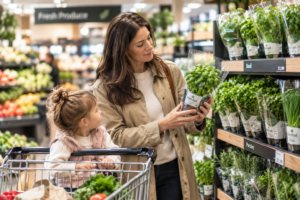
The researchers asked 250 German consumers to make choices between different packaging options for fresh potted herbs. The results provide some interesting lessons for companies considering a switch from conventional plastic to more sustainable food packaging.
Consumers showed a clear preference for alternatives to conventional plastic
The overall findings were quite clear: consumers generally preferred paper, home-compostable and packaging-free options over conventional plastic.
For film packaging, paper was the most preferred material, followed by corn-starch-based film. Conventional plastic was the least preferred option.
For the plant pot, home-compostable packaging was the most preferred option, followed by having no pot at all. Again, conventional plastic was the least preferred.
This does not mean that every food product should simply replace plastic with paper or compostable packaging. Different products have different requirements for shelf life, strength, moisture resistance, sealing and production equipment.
But the research does indicate that consumers can have a positive attitude towards packaging materials that provide a clear alternative to conventional plastic.
Sustainability is not the only consideration
Perhaps more importantly for packaging buyers, the study shows that consumers are not making decisions based on environmental credentials alone.
Price and packaging material were both significant factors in consumer choice. Price accounted for approximately 32% of the decision, while film packaging material accounted for around 24%.
This reinforces an important point for businesses: sustainable packaging needs to work commercially as well as environmentally.
A packaging solution that looks good environmentally but is too expensive, does not protect the product properly or cannot run efficiently on existing equipment is unlikely to be a practical long-term solution.
For companies assessing sustainable food packaging, the questions should therefore go beyond simply asking whether a material is “green”.
Does it provide the required product protection? Can it run on existing packing lines? What is the cost? And, importantly, what happens to the packaging after it has been used?
Consumers are not one group
The research also identified three distinct consumer groups.
The largest group, described as environmentally conscious, represented 61.6% of the sample. These consumers placed greater importance on packaging and environmental attributes and were less focused on price.
A second group, representing 24.8%, was primarily price and convenience driven. Price accounted for approximately 75% of their decision, showing that sustainable packaging also needs to be commercially accessible.
The final group, 13.6%, was described as green and skeptical. These consumers were environmentally concerned but also more doubtful about environmental claims.
That last finding is particularly relevant for brands. Consumers may want better packaging while simultaneously questioning whether sustainability claims are genuine.
Clear, credible information matters
The study highlights the potential problem with terms such as bio-based, biodegradable and compostable. Consumers may not fully understand the differences, particularly when alternative materials look almost identical to conventional plastic.
For businesses, this creates an important responsibility: make sustainability claims clear, specific and verifiable.
Rather than relying on broad environmental language, companies should understand the actual properties and end-of-life options of their chosen packaging and communicate them accurately.
What does this mean for packaging decisions?
The research does not identify one universal “best” packaging material. Instead, it reinforces the need to look at the complete packaging requirement.
Consumers appear receptive to alternatives to conventional plastic, particularly paper and compostable solutions. But price, convenience and performance still matter – and some consumers will scrutinise sustainability claims closely.
For businesses considering a change, the best approach is therefore to assess the material, application, performance, cost and end-of-life solution together.
At Treetop Biopak, we supply compostable packaging solutions designed to meet practical performance requirements and run on standard packing lines. We believe the objective is not simply to replace plastic, but to find a packaging solution that protects the product and provides a better end-of-life option.
If you are assessing alternatives to conventional plastic packaging, talk to us about the materials and options available for your application.